

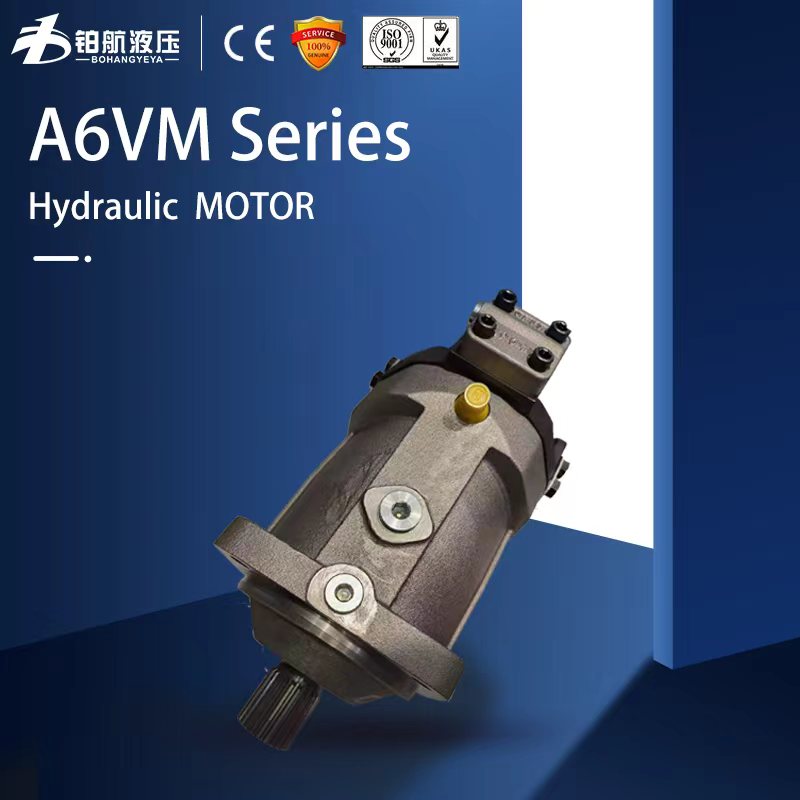
Choosing an axial piston motor starts with the work the machine must do, not with a model number. Define the starting and running torque, speed range, available pressure and flow, duty cycle, circuit type, and installation interface. Then calculate a preliminary displacement and check it against the manufacturer's operating data. Correct displacement alone is not enough. Continuous pressure, case pressure, shaft load, control type, and mounting must also suit the machine.
Quick Selection Checklist
Before comparing motors, collect these values:
- Starting, continuous, and peak torque
- Minimum, normal, and maximum shaft speed
- Continuous and peak inlet pressure
- Return line pressure and available flow
- Open or closed hydraulic circuit
- Duty cycle and fixed or variable displacement requirement
- Flange, shaft, ports, rotation, and installation space
- Brake, sensor, flushing, fluid, and temperature requirements
If these values are unknown, measure the existing system before ordering. Matching only displacement or outside dimensions is not enough.
1. Start With the Load and Torque
Pressure does not create the same torque in every motor. Output torque depends on motor displacement and the effective pressure difference between the high pressure and low pressure ports.
The theoretical motor torque is: T = Δp × Vg ÷ 62.8
Where:
- T is theoretical torque in Nm
- Δp is the pressure difference in bar
- Vg is displacement in cm³/rev
Actual torque is lower because of mechanical losses: T actual = T theoretical × mechanical efficiency
Use pressure difference, not pump outlet pressure alone. If the inlet pressure is 300 bar and the return pressure is 20 bar, the available pressure difference is 280 bar.
Separate starting, continuous, and short duration peak torque. A loaded winch, track, or mixer may need more torque to start than to keep moving. Use the manufacturer’s starting efficiency and peak pressure data for the final check.
2. Calculate Displacement, Flow, and Power
Rearrange the torque equation to estimate displacement: Vg = 62.8 × T required ÷ (Δp × mechanical efficiency)
Motor speed is related to flow, displacement, and volumetric efficiency: n = 1,000 × Q × volumetric efficiency ÷ Vg
Where n is rpm and Q is L/min. The flow required for a target speed is: Q = n × Vg ÷ (1,000 × volumetric efficiency)
Hydraulic input power can be estimated as: P hydraulic = Δp × Q ÷ 600
Shaft output power is: P output = T × n ÷ 9,550
These equations support preliminary sizing. Final selection requires the efficiency map, torque and speed envelope, temperature limits, and continuous operating area.
Worked Sizing Example
Consider a drive requiring 900 Nm starting torque and 300 rpm. Inlet pressure is 300 bar and return pressure is 20 bar. For preliminary sizing, assume 0.88 mechanical efficiency and 0.94 volumetric efficiency. Replace these assumptions with product data.
The preliminary displacement for starting is: Vg = 62.8 × 900 ÷ (280 × 0.88) = 229.4 cm³/rev
A nearby standard displacement, such as 250 cm³/rev, can be evaluated. At 300 rpm, estimated flow is: Q = 300 × 250 ÷ (1,000 × 0.94) = 79.8 L/min
At 280 bar, hydraulic input power is about 37.2 kW. Before ordering, verify that the candidate can deliver starting torque, accept about 80 L/min, run continuously at the required pressure and speed, and stay within its thermal limits.
3. Choose Fixed or Variable Displacement
| Operating need | Fixed displacement | Variable displacement |
|---|---|---|
| Relatively constant speed and load | Usually suitable | May add unnecessary complexity |
| Wide speed range from one pump flow | Limited | Suitable |
| High torque at low speed and faster travel at light load | Requires other system changes | Often suitable |
| Simple control and easier maintenance | Advantage | More controls to verify |
| Travel drive or changing machine load | Possible in some systems | Common choice |
A fixed motor provides a consistent relationship between flow and speed and suits many stable conveyors, fans, and process drives. A variable motor changes the torque and speed relationship during operation. More displacement supports torque and reduces speed. Less displacement increases speed, but minimum displacement, inlet pressure, and maximum speed limits still apply.
4. Choose Bent Axis or Swashplate Construction
Bent axis motors place the cylinder block at an angle to the shaft. They are often considered for high pressure, speed, and demanding starts. Fixed and variable versions are available.
Swashplate motors arrange the pistons parallel to the shaft. Their compact layout can help where space, control integration, or gearbox packaging matters.
Compare each design's pressure, speed, starting performance, controls, shaft capacity, case pressure, and installation drawing.
5. Check Continuous, Intermittent, and Peak Ratings
Maximum pressure is not necessarily continuous pressure. Current Bohang A6VM data lists 400 bar nominal and 450 bar maximum for sizes 28 to 200, but 350 bar nominal and 400 bar maximum for sizes 250 to 1000.
Speed limits also change with displacement. The Bohang A2FM table shows higher permitted speeds for small units and lower speeds for large units. Verify pressure and speed together against the expected duty.
ISO 4409:2019 defines methods for presenting steady state performance and efficiency of positive displacement pumps and motors. Ask suppliers for the test method, oil temperature, viscosity, pressure, speed, and measurement tolerance.
6. Match the Motor to the Hydraulic Circuit
Confirm whether the system is open or closed circuit. Also check:
- Required charge or makeup pressure
- Main port and return line pressure limits
- Case drain location and allowable case pressure
- Flushing flow for cooling and oil renewal
- Relief, anti shock, or counterbalance valves
- Brake release pressure
- Protection against overrunning loads and cavitation
Keep the motor case filled with clean oil and route the drain with low restriction. Excessive case pressure can damage shaft seals or change control behavior. Use the limit for the exact motor and installation position.
Winches, cranes, and downhill drives may require a brake and counterbalance valve for load holding and controlled lowering.
7. Verify Mechanical and Fluid Compatibility
For a new design or replacement, compare more than the model family:
- Mounting flange and pilot diameter
- Bolt pattern
- Shaft diameter, key, or spline
- Shaft length and permitted radial or axial load
- Main, drain, flushing, and control ports
- Direction of rotation
- Brake and speed sensor connections
- Overall envelope and gearbox interface
Check fluid type, operating and cold start viscosity, seal material, filtration, and temperature. Thick cold oil can restrict filling, while thin hot oil can increase leakage and reduce torque.
8. Match the Motor Family to the Application
Bohang's hydraulic motor range includes several configurations for replacement and OEM projects.
| Requirement | Motor family to evaluate |
|---|---|
| Fixed displacement, bent axis, standard mounting | A2FM |
| Variable displacement and wide control range | A6VM |
| Fixed plug in motor for gearbox integration | A2FE |
| Fixed swashplate motor for mobile or industrial drives | A10FM |
| Nonstandard pressure, mounting, shaft, or control needs | Custom motor solution |
Common Selection Mistakes
- Choosing by displacement alone
- Using inlet pressure instead of effective pressure difference
- Ignoring starting torque and minimum stable speed
- Treating peak pressure as a continuous rating
- Selecting a larger motor without checking available flow and heat
- Ignoring case drain and back pressure
- Assuming similar model codes have identical shafts, ports, and controls
- Checking maximum values separately instead of verifying the complete operating point
Information to Send With an Inquiry
Provide the application, torque, speed, inlet and return pressure, flow, circuit, duty, fluid, temperature, mounting, brake, sensor, and control requirements.
For a replacement, include the full nameplate code, photographs, and an installation drawing. Bohang can review standard options or assess a custom hydraulic motor solution.
FAQ
Q1. Is a larger axial piston motor always safer?
A: No. A larger displacement may increase torque at the same pressure, but it also requires more flow for the same speed. Oversizing can increase cost, slow the drive, and create a mismatch with the pump.
Q2. Can a pump be used as a motor?
A: Only when the specific unit is designed and approved for motor operation. Similar internal construction does not guarantee suitable porting, bearings, sealing, controls, or back driving capability.
Q3. Can two motors with the same displacement be interchanged?
A: Not automatically. Pressure rating, speed limit, shaft, flange, ports, rotation, case drain, control, and permissible external loads must also match.
Q4. What usually causes low torque after installation?
A: Common causes include insufficient pressure difference, excessive return pressure, internal leakage, incorrect displacement control, low pump flow, relief valve settings, or a load higher than the original calculation.
Choosing the right axial piston motor is a system decision. Start with measured load and speed requirements, calculate a preliminary displacement, then verify the complete operating point and installation details. If you have a motor code or working condition sheet, contact Bohang Hydraulic for a technical review before ordering.
Conclusion
Choosing the right axial piston motor means matching the motor to the machine, not simply copying a model number. Start with starting and running torque, speed, effective pressure difference, flow, duty cycle, and circuit type. Use these values to estimate displacement, flow, and power, then decide between fixed or variable displacement and bent axis or swashplate construction. Finally, verify continuous ratings, case drain, fluid, shaft, flange, ports, controls, and protection devices. A motor is correctly selected only when its complete operating point and installation match the application.