
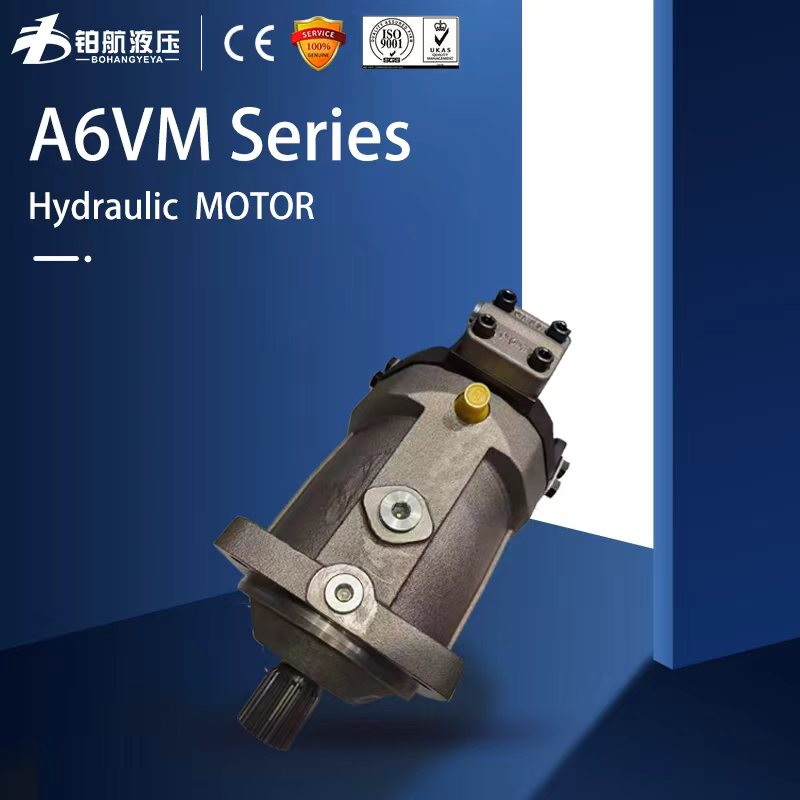
A hydraulic axial piston motor converts the pressure and flow of hydraulic oil into rotary speed and torque. Inside the motor, several pistons are arranged parallel, or nearly parallel, to the output shaft. Pressurized oil moves these pistons, while an angled swash plate or bent axis mechanism turns their linear movement into shaft rotation.
For buyers, the practical questions are whether the motor will produce enough starting torque, run continuously at the required speed, and fit the existing interface. The answer depends on displacement, pressure difference, flow, control, and installation conditions.
This guide explains those choices using real operating data from Bohang's hydraulic motor range, including fixed and variable displacement units for open and closed circuits.
How Does a Hydraulic Axial Piston Motor Work?
Oil enters the high pressure port and is directed through a valve plate to a group of cylinder bores. Pressure acts on the piston faces and creates axial force. Because the pistons work against an inclined surface, that force creates a turning moment on the cylinder block and output shaft. Oil then leaves through the low pressure port and returns to the circuit.
1. Displacement is the theoretical oil volume per shaft revolution, stated in cubic centimeters per revolution.
2. Flow mainly determines speed.
3. Pressure difference mainly determines torque.
4. Efficiency accounts for leakage and friction.
For a quick engineering estimate: Estimated speed: n = 1000 × Q × ηv ÷ Vg Estimated torque: T = Δp × Vg × ηm ÷ (20π)
Here, n is speed in rpm, Q is flow in L/min, Vg is displacement in cm³/rev, Δp is pressure difference in bar, ηv is volumetric efficiency, and ηm is mechanical efficiency.
For example, an 80 cm³/rev motor receiving 120 L/min with an assumed volumetric efficiency of 0.94 has an estimated speed of 1,410 rpm. At a pressure difference of 280 bar and an assumed mechanical efficiency of 0.90, estimated torque is about 321 N·m. These are selection estimates. Final values should be checked against the model data and the real duty cycle.
Main Axial Piston Motor Designs
Swash Plate and Bent Axis Motors
A swash plate motor uses pistons parallel to the shaft and an inclined plate to create piston stroke. It is useful where installation space and control integration matter.
A bent axis motor places the cylinder block at an angle to the shaft, supporting high torque density and a wide speed range. Bohang A2FM fixed motors and A6VM variable motors use this design in open and closed circuits.
| Design choice | What it changes | Suitable situations |
|---|---|---|
| Fixed displacement | Constant oil volume per revolution | Drives needing predictable speed for a given flow |
| Variable displacement | Adjustable oil volume per revolution | Machines that need speed and torque control without changing pump flow |
| Swash plate | Compact axial layout | Integrated mobile and industrial drives |
| Bent axis | Wide operating range and high torque density | Travel, winch, mixer, conveyor, and heavy duty drives |
Fixed or Variable Displacement?
A fixed displacement motor gives predictable speed for a known flow. Bohang A2FM Series 6x motors cover approximately 4.93 to 1,000 cm³/rev. Depending on frame size, nominal pressure ratings are 315, 350, or 400 bar, with maximum ratings from 350 to 450 bar.
A variable motor changes piston stroke. Increasing displacement reduces speed for the same flow and raises torque capability for the same pressure. Reducing displacement raises potential speed, but the minimum setting must protect lubrication and prevent overspeed. Bohang A6VM Series 6x covers 28 to 1,000 cm³/rev with hydraulic, electric proportional, and automatic controls.
What Performance Data Should You Check?
Do not select a motor from displacement and maximum pressure alone. Compare these items with the machine duty:
| Selection item | What to verify |
|---|---|
| Nominal pressure | Pressure during most of the operating cycle |
| Maximum pressure | Duration and frequency of pressure spikes |
| Maximum speed | Overspeed risk at low displacement or with an overrunning load |
| Required torque | Starting, running, and holding torque |
| Circuit type | Open or closed circuit, flushing, braking, and control |
| Case pressure | Correctly sized, unrestricted case drain |
| Oil condition | Suitable cleanliness and viscosity across the temperature range |
A size 10 unit is listed at 10.3 cm³/rev, up to 8,000 rpm, and 66 N·m at nominal pressure. A size 107 is listed at 106.7 cm³/rev, up to 4,000 rpm, and 679 N·m. A size 1000 is listed at 1,000 cm³/rev, up to 1,800 rpm, and 5,570 N·m. These are not interchangeable operating points. Review pressure, speed, power, and duty limits together.
Bohang motor options follow common metric and SAE interfaces, including ISO 3019-2 and SAE J744 configurations. ISO 3019-2 covers metric mounting flanges and shaft ends for displacement pumps and motors. Buyers should still confirm pilot diameter, bolt pattern, shaft, ports, rotation, and envelope from the drawing.
Where Are Hydraulic Axial Piston Motors Used?
These motors are commonly selected when a machine needs substantial torque from a compact hydraulic drive:
- Excavator, loader, grader, bulldozer, and paver travel drives
- Winches, cranes, and material handling systems
- Concrete mixer drum drives
- Mining, drilling, and tunneling equipment
- Industrial conveyors and production machinery
- Agricultural and forestry equipment
In a published construction machinery configuration, Bohang pairs an A4VTG pump with an AA6VM or A2FE motor for a concrete mixer. The motor must start a loaded drum, control speed as conditions change, and work with relief and flushing functions. Load variation, cooling, circuit protection, and control response matter as much as flange size.
For travel drives, an A6VM or plug in A6VE can provide high torque at low speed and lower displacement at higher speed. An A2FM or A2FE may suit a drive where the transmission handles the speed ratio.
How to Choose the Right Motor
Start with the machine, not the model code.
- Define the load: Record continuous, starting, and peak torque, load direction, and overrunning conditions.
- Define the speed range: Include creep, normal, maximum, and possible overspeed.
- Confirm available hydraulics: Provide flow, inlet and return pressure, case pressure, and oil temperature.
- Choose the displacement type: Use fixed displacement for simple speed behavior. Consider variable displacement for a wider speed range or coordinated control.
- Match the interface: Check shaft, flange, pilot, ports, rotation, space, and coupling loads.
- Review the circuit: Confirm circuit type, flushing, brake valves, charge pressure, and drain routing.
- Validate the duty cycle: Separate continuous operation from short peaks. Maximum pressure is not normal working pressure.
Expert Installation Tips
Fill the housing with clean oil before startup. For A6VM installations, a horizontal shaft and upper drain port used for venting help remove trapped air. Keep the case drain unrestricted, verify rotation, and commission at low pressure and speed while checking leakage, temperature, noise, and vibration.
Avoid reducing a variable motor below its approved minimum displacement. Do not assume an old model code confirms every interface, since revisions can change controls and ports. Also account for breakaway load, not only running torque.
Questions to Ask a Hydraulic Axial Piston Motor Manufacturer
Ask whether the motor is tested for leakage, noise, and volumetric performance under load. Request the exact data sheet and drawing. Confirm inspection records, warranty, spare parts, and commissioning support.
For a replacement or customized motor, send the nameplate, photos, interface dimensions, control code, and operating data. Bohang can review mounting, shaft, ports, displacement, and controls before production, reducing the risk of a physical fit that does not match the hydraulic system.
FAQ
Q1. Is an axial piston motor the same as an axial piston pump?
A: They use related rotating groups, but energy direction differs. A pump creates hydraulic flow from shaft power. A motor creates shaft power from hydraulic energy. Use a unit only in its approved role.
Q2. Does higher hydraulic pressure make the motor run faster?
A: Pressure difference mainly creates torque. Flow mainly controls speed. Speed may fall under load if leakage rises or the available flow changes.
Q3. Can an axial piston motor run in both directions?
A: Many models can operate in both directions, but porting, control, brake, and flushing arrangements must support the required direction. Confirm the exact model configuration.
Q4. When should I choose a variable displacement motor?
A: Choose it for a broad speed range, high torque at low speed, coordinated control, or changing loads.
Q5. What information is needed for a replacement quotation?
A: Send the original model code and nameplate, required displacement, working and peak pressure, flow, target speed and torque, circuit type, shaft, flange, ports, rotation, control type, oil temperature, and annual quantity.
Conclusion
hydraulic axial piston motor converts pressurized oil into rotary torque and speed. Axially arranged pistons act against a swash plate or bent axis mechanism, while oil flow controls speed and pressure difference determines torque. Fixed displacement motors suit consistent operating requirements, while variable motors provide a broader speed and torque range. Selection depends on displacement, continuous and peak pressure, flow, circuit type, case drainage, mounting, shaft, and ports. Review Bohang hydraulic motors or contact Bohang now with your working data for model selection.