

When a hydraulic machine must move smoothly, hold a repeatable speed, or adjust force during a working cycle, an on-off valve is often too limited. Proportional valves provide continuous control by changing flow, pressure, or direction in response to an electrical command. This makes them useful in mobile hydraulics, industrial equipment, material handling, and automated machinery.
The important point for buyers is that a proportional valve is not selected by the word "proportional" alone. The correct choice depends on the controlled variable, maximum flow, pressure, mounting interface, electrical signal, oil cleanliness, and required repeatability.
What Does a Proportional Valve Do?
A hydraulic proportional valve converts an electrical command into a controlled change in valve opening. A larger or smaller current or voltage moves the solenoid and spool to a corresponding position. The spool then regulates the amount of oil passing through the valve or changes the pressure applied to an actuator.
Unlike a conventional solenoid valve, which normally switches between defined positions, a proportional valve can provide intermediate positions. The result is adjustable cylinder speed, smoother acceleration and deceleration, controllable motor speed, and variable pressure or force.
The three main functions are:
- Directional control: directs oil to extend, retract, start, stop, or reverse an actuator.
- Flow control: regulates actuator speed or the volume of oil delivered to a circuit.
- Pressure control: adjusts force, clamping pressure, or system pressure according to the command signal.
How Hydraulic Proportional Valves Work
The control process can be understood in four steps:
- A controller sends a voltage, current, PWM, or fieldbus command.
- The proportional solenoid generates a force related to the input signal.
- The solenoid shifts the spool against a spring or hydraulic force.
- The spool opening changes the flow path, pressure, or actuator movement.
In an open-loop valve, the controller assumes that the spool reaches the requested position. In a closed-loop design, a position sensor such as an LVDT reports spool movement back to the controller. Closed-loop control is preferred when the application requires repeatability, stable response under changing loads, or accurate position, force, or velocity control.
The electrical interface must be confirmed before ordering. Depending on the series, the system may use 24 V DC, current, 0–10 V, ±10 V, PWM, CAN bus, or another digital interface. A valve with the wrong coil, connector, amplifier, or signal range may fit mechanically but fail to operate correctly.
Main Types of Proportional Valves
Proportional Directional Valves
These valves control the direction and speed of hydraulic cylinders or motors. They are common in excavators, graders, loaders, lifting equipment, and automated machinery. Spool design, flow capacity, neutral position, and pressure drop determine how smoothly the actuator starts, stops, and reverses.
Proportional Pressure Valves
Pressure-reducing and pressure-relief versions adjust pressure according to an electrical input. They are suitable for clamping, forming, injection, force control, and overload protection. The selected pressure range must match the real working pressure, not only the maximum setting shown in a catalogue.
Proportional Flow Control Valves
These valves regulate flow to control actuator speed. Pressure compensation is important when the load changes. Without suitable compensation, the same command may produce different speeds at different loads.
Direct-Operated and Pilot-Operated Valves
Direct-operated valves have a simple signal path and are often suitable for smaller or medium flow requirements. Pilot-operated valves use a pilot stage to control a larger main stage and are used when the system needs higher flow capacity. The trade-off involves response, installation space, circuit complexity, and cost.
Proportional Valve vs. On-Off Valve vs. Servo Valve
| Feature | On-Off Valve | Proportional Valve | Servo Valve |
|---|---|---|---|
| Control | Fixed positions | Continuous variable control | High-precision continuous control |
| Typical use | Simple switching | Speed, pressure, and direction control | High-dynamic position or force control |
| Cost | Lower | Moderate | Higher |
| System tolerance | Generally robust | Requires correct tuning and clean oil | Usually more sensitive to contamination |
| Best reason to choose | Simple and economical movement | Smooth, adjustable, repeatable control | Maximum dynamic accuracy |
A proportional valve is often the practical middle option. It improves abrupt on-off motion without the cost and maintenance demands of a high-precision servo system. However, performance depends on the complete circuit. A Hydraulic Valves cannot compensate for an undersized pump, excessive restriction, unstable load, air in the oil, or an unsuitable controller.
How to Select the Correct Proportional Valve
1. Define the Control Objective
Start with the result you need: direction, flow, pressure, speed, force, position, or a combination. If a cylinder moves too quickly at the end of its stroke, a flow or directional solution may be appropriate. If clamping force is inconsistent, pressure control may be the better starting point.
2. Calculate Flow and Pressure
Record the maximum and minimum flow, continuous and peak pressure, operating temperature, duty cycle, and expected load. A useful first estimate of hydraulic power is: Power (kW) ≈ Pressure (bar) × Flow (L/min) ÷ 600
For example, 210 bar and 60 L/min represents approximately 21 kW of hydraulic power before efficiency losses. The valve must be sized for maximum flow while maintaining acceptable pressure drop. Oversizing can make low-flow control difficult; undersizing can create heat, noise, and poor response.
3. Confirm the Mounting Interface
Check the existing manifold, subplate, port size, valve size, spool code, and electrical connector. ISO 4401:2005 defines mounting dimensions for four-port hydraulic directional control valves to support interchangeability. A compatible mounting pattern reduces modification work, but it does not guarantee that the spool function, flow rating, or electrical control is compatible.
4. Choose Open-Loop or Closed-Loop Control
Open-loop control is suitable for many general-purpose speed and pressure applications. Choose feedback when the application requires high repeatability, precise motion, or stable control as the load changes. Discuss the complete controller and sensor arrangement with the valve supplier before placing an OEM order.
5. Check Oil Cleanliness and Environment
Contamination is one of the most common causes of hydraulic valve failure. ISO 4406:2021 provides a coding method for defining solid-particle contamination in hydraulic fluid. Buyers should request the recommended cleanliness level for the selected valve and confirm filtration, flushing, storage, and maintenance procedures.
Also verify fluid type, viscosity, temperature, seal material, corrosion exposure, vibration, and hazardous-area requirements.
Practical Applications
In construction machinery, proportional control helps coordinate pumps, motors, cylinders, and directional functions. Bohang's grader solution combines variable pumps, motors, and M4 proportional valves for blade control. The Hydraulic Valves should be evaluated together with the pump, actuator, load-sensing circuit, and controller.
In industrial equipment, proportional valves are used for auxiliary axes, clamping, injection, forming, and controlled ram movement. Bohang's industrial portfolio covers CNC machines, forging equipment, injection molding, metal forming, and metallurgy. These applications require clear pressure, flow, response, and repeatability requirements rather than a generic "high precision" claim.
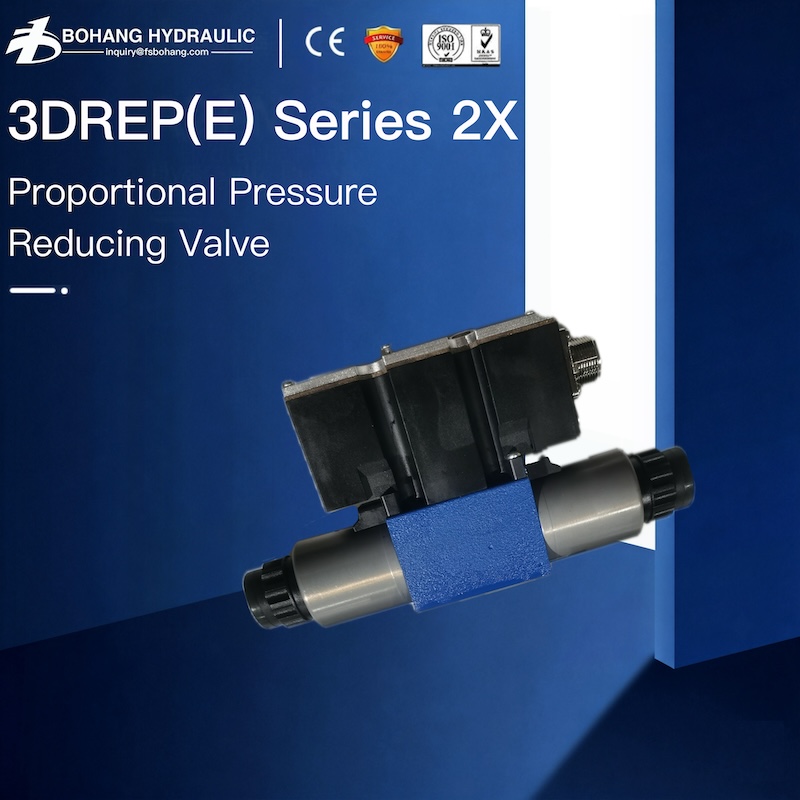
For replacement projects, model identification is equally important. Bohang lists a 3DREP(E) replacement proportional pressure-reducing valve with a maximum pressure of 100 bar at port P, 30 bar at port T, a maximum flow of 15 L/min at a stated pressure differential, and an ISO 4401/CETOP 3 size 6 mounting pattern. These are model-specific values and must not be applied to every proportional valve.
Commissioning and Troubleshooting Tips
Before commissioning, flush the circuit, verify coil voltage, check the connector pinout, remove trapped air, and begin testing at low pressure. Set ramp time and maximum command gradually. Monitor pressure, flow, temperature, actuator movement, and current.
If the actuator moves abruptly, check for air, incorrect spool selection, insufficient pressure compensation, or unsuitable ramp settings. If the valve responds slowly, check signal range, flow capacity, pressure drop, contamination, and controller tuning. If the system overheats, investigate excessive throttling and unnecessary pressure loss. Stable proportional control requires both a correctly sized valve and a correctly prepared hydraulic circuit.
Why Work with Bohang Hydraulic?
Bohang supplies hydraulic pumps, motors, valves, replacement components, and custom hydraulic solutions for mobile and industrial systems. Its valve range includes proportional, directional, pressure, check, and throttle-check products.
For OEM projects, Bohang's custom process is based on pressure, flow, torque, mounting structure, and control performance. The process covers requirement analysis, custom design, prototype testing, mass production, and global delivery.
When requesting a proportional valve quotation, provide the existing model number or drawing, working pressure, maximum flow, mounting standard, control signal, fluid, temperature, application, and quantity.
Select the proportional valve as part of the system, not as an isolated component. Send your operating parameters to Bohang Hydraulic for a compatibility review, replacement recommendation, or custom valve solution.
FAQ
Q1. What is the main advantage of a proportional valve?
A: It provides continuous control of flow, pressure, or direction, allowing smoother and more adjustable machine movement than a basic on-off valve.
Q2. Do proportional valves need an amplifier?
A: Some models require an external amplifier or controller, while others include onboard electronics. Confirm the signal, current range, connector, and controller compatibility before ordering.
Q3. How do I size a proportional valve?
A: Confirm the required flow, pressure, pressure drop, control objective, mounting pattern, electrical signal, oil cleanliness, and environmental conditions. Then select a model using its performance curves and technical datasheet.
Q4. Can Bohang provide custom proportional valves?
A: Yes. Bohang's custom valve service can be developed around application pressure, flow, mounting structure, control performance, and OEM integration requirements.
Conclusion
Proportional valves deliver electrically controlled hydraulic flow, pressure, and directional control. This guide explains valve types, operation, sizing, installation, and troubleshooting, helping OEMs select reliable proportional valve solutions for industrial and mobile machinery for precise, efficient automation and system integration.