

Quick Answer
A hydraulic axial piston motor converts pressurized oil into shaft rotation. A valve plate sends oil into selected piston chambers. Pressure pushes the pistons against an angled swash plate or through a bent axis rotating group. This creates tangential force, turning the cylinder block and output shaft. The oil then exits through the low pressure port.
Key Points at a Glance
- Pressure mainly determines torque.
- Flow mainly determines speed.
- Displacement affects both torque and speed.
- Fixed motors keep one displacement.
- Variable motors change displacement to suit different operating modes.
At Bohang, we evaluate the operating point, not only the model. A matching flange and shaft do not confirm hydraulic compatibility.
How Does the Motor Produce Rotation?
An axial piston hydraulic motor is a positive displacement motor. Its pistons move inside bores arranged around the cylinder block axis. Each revolution uses a measured volume of hydraulic oil.
The working cycle has six stages:
1. Oil enters: High pressure oil enters through port A or port B, depending on the required rotation direction.
2. Flow is timed: The valve plate connects the inlet to a group of cylinder bores.
3. Pistons are loaded: Oil pressure acting on piston area creates axial force.
4. Force changes direction: A swash plate or bent axis mechanism creates a tangential force.
5. The shaft turns: The cylinder block and output shaft rotate under load.
6. Oil returns: Each cylinder reaches the outlet side, and the piston discharges oil through the low pressure port.
Several pistons overlap their power strokes. This produces smoother shaft torque than a single piston could provide.
Reversing the working ports generally reverses rotation, provided the circuit meets the motor's drain and control requirements.
What Are the Main Parts of an Axial Piston Motor?
| Component |
|
|
| Cylinder block | Holds the piston bores and rotates with the shaft | Internal leakage and reduced loaded speed |
| Pistons | Convert oil pressure into axial force | Loss of torque, scoring or unstable operation |
| Piston shoes or joints | Transfer piston force to the angled mechanism | Noise, friction and heat |
| Valve plate | Times inlet and outlet flow and forms a sealing face | High case drain and lower volumetric efficiency |
| Bearings | Support the rotating group and shaft loads | Vibration, noise and rising temperature |
| Case drain | Removes leakage oil and helps control housing pressure | Seal damage if restricted |
Small internal clearances depend on clean oil for lubrication. Oil condition, viscosity and temperature also affect torque, speed and response.
What Is the Difference Between Swash Plate and Bent Axis Designs?
Both designs convert piston force into rotation, but their internal geometry differs.
Swash Plate Motor: The piston bores are parallel to the shaft. Piston shoes move against an inclined plate. Changing the plate angle changes piston stroke and displacement.
Bent Axis Motor: The cylinder block is angled relative to the output shaft. Pistons connect to a drive flange, and the angled rotating group converts piston force into shaft torque.
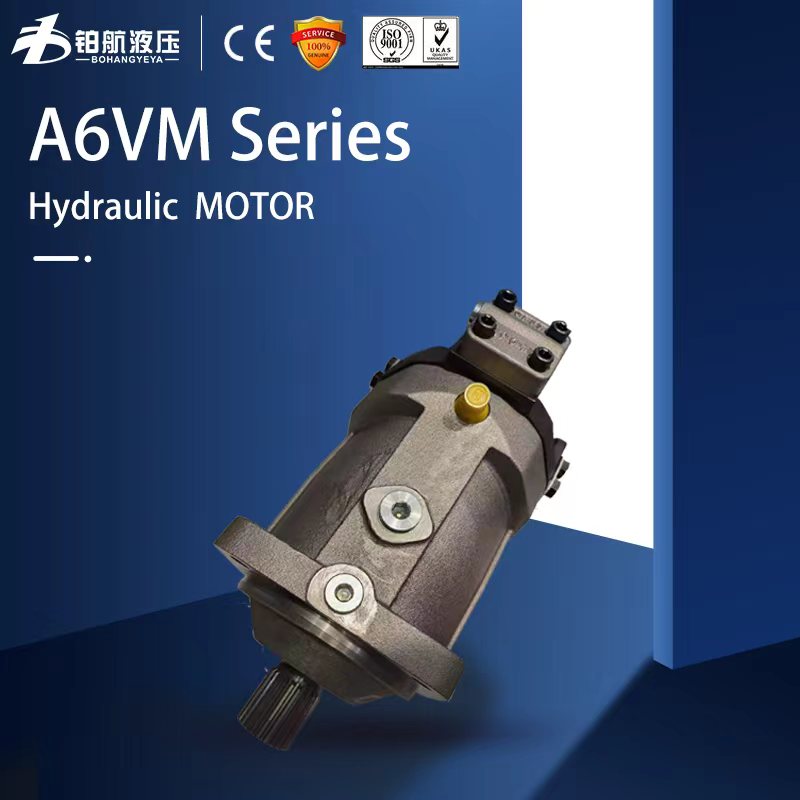
The Bohang A2FM fixed displacement motor and Bohang A6VM variable displacement motor use bent axis rotating groups. A swash plate drawing is not an internal drawing of these models.
Fixed or Variable Displacement: Which One Do You Need?
| Selection point | Fixed displacement motor |
|
| Oil volume per revolution | Approximately constant | Adjustable within the control range |
| Main speed adjustment | Change inlet flow | Change flow, displacement or both |
| Torque response | Mainly pressure difference and fixed displacement | Pressure difference and current displacement |
| Control complexity | Lower | Higher |
| Typical use | Stable, predictable duty |
|
A fixed motor suits predictable duties. A variable motor can use high displacement for working torque and lower displacement for faster travel.
Control compatibility remains critical. An incorrect hydraulic or electric command can cause early, late or abrupt shifting.
What Controls Motor Torque, Speed and Power?
The relationships are straightforward:
- More pressure difference produces more torque.
- More inlet flow produces more speed.
- More displacement produces more torque per bar but fewer revolutions for the same flow.
- Less displacement produces more speed but less torque per bar.
Use these equations for preliminary checks:
Theoretical torque, N m
Pressure difference in bar × displacement in cm³ per revolution ÷ 62.83
Theoretical speed, rpm
1000 × flow in litres per minute ÷ displacement in cm³ per revolution
Hydraulic input power, kW
Pressure difference in bar × flow in litres per minute ÷ 600
Real output is lower because of leakage and mechanical friction. Use measured volumetric efficiency when estimating actual speed and measured mechanical efficiency when estimating available torque.
What Information Is Needed to Select a Replacement?
Send the following information with the inquiry:
- Complete nameplate and model code
- Machine type and motor function
- Required displacement, torque and speed
- Continuous and peak pressure
- Available pump flow
- Shaft, flange and port details
- Rotation direction
- Open or closed circuit
- Case drain arrangement and housing pressure
- Control type and control signal for a variable motor
- Hydraulic oil grade, temperature and cleanliness target
- Photographs, dimensions and a short symptom video for a replacement
Two motors can share the same mounting dimensions but behave differently because of their displacement, port position, control curve or drain limit.
Bohang's custom hydraulic solution process begins with pressure, flow, torque, mounting and control requirements, followed by design review and prototype testing. Request a confirmed code, drawing and test record before production.
Quick Troubleshooting Guide
| Symptom |
|
| Low speed under load | Pressure difference, inlet flow, oil temperature and case drain trend |
| Low torque | System pressure, displacement setting, relief valve and mechanical load |
| Excessive noise | Oil level, aeration, coupling alignment, drain restriction and bearing condition |
| Shaft seal leakage | Housing pressure, drain line restriction and seal condition |
| Jerking during displacement change | Command signal, beginning of control setting and control pressure |
| Rising oil temperature | Internal leakage, viscosity, cooling capacity and continuous duty point |
Before first start, fill the motor housing with clean oil through the highest accessible case port. Vent trapped air, confirm rotation and begin at low pressure and low speed where the machine procedure allows it.
There is no universal case drain value. Compare measurements with the motor documentation and commissioning baseline, then watch for a rising trend under the same load.
Where Are Axial Piston Motors Used?
Fixed and variable bent axis motors are used in mobile and stationary hydraulic systems. Published Bohang application information includes:
- Road rollers and pavers
- Loaders and graders
- Cranes and winches
- Drilling rigs
- Milling and construction equipment
- Marine and offshore equipment
- Industrial rotary drives
Machine type alone cannot determine the motor. Similar pressure does not mean identical braking, overspeed or starting requirements.
FAQ
Q1. Does Higher Pressure Make an Axial Piston Motor Run Faster?
A: Not directly. Pressure mainly creates torque, while flow mainly determines speed.
Q2. Why Does Motor Speed Fall Under Load?
A: The motor may need more pressure to overcome the load. Internal leakage can also rise with pressure and temperature, reducing the flow available for rotation.
Q3. Can an Axial Piston Motor Run in Both Directions?
A: Many models can reverse when the high pressure and return ports are switched. Confirm the specific circuit, rotation, valve arrangement and case drain requirements first.
Q4. Can a Hydraulic Motor Be Used as a Pump?
A: The operating principles are related, but a motor should only be used as a pump when its documentation permits it. Bearings, controls, porting, lubrication and speed limits may differ.
Q5. Why Can a Variable Motor Overspeed at Small Displacement?
A: The same inlet flow produces more revolutions as displacement decreases. The minimum displacement setting must keep speed within the motor limit and maintain lubrication.
Q6. What Causes an A6VM Motor to Jerk When Changing Speed?
A: A mismatch in the command signal, control pressure or beginning of control setting can cause an abrupt transition. Confirm these values before replacing the rotating group.
Conclusion
A hydraulic axial piston motor uses a valve plate to direct pressurized oil into a rotating cylinder block. Its pistons convert pressure into force, while a swash plate or bent axis mechanism turns that force into shaft rotation. Pressure controls torque, flow controls speed, and displacement affects both. Reliable operation depends on the model code, control setting, case drain, oil condition and speed limit. When selecting a fixed or variable motor, compare the operating point, not only the flange and shaft. Send Bohang pressure, flow, torque, speed and machine details for application review.