
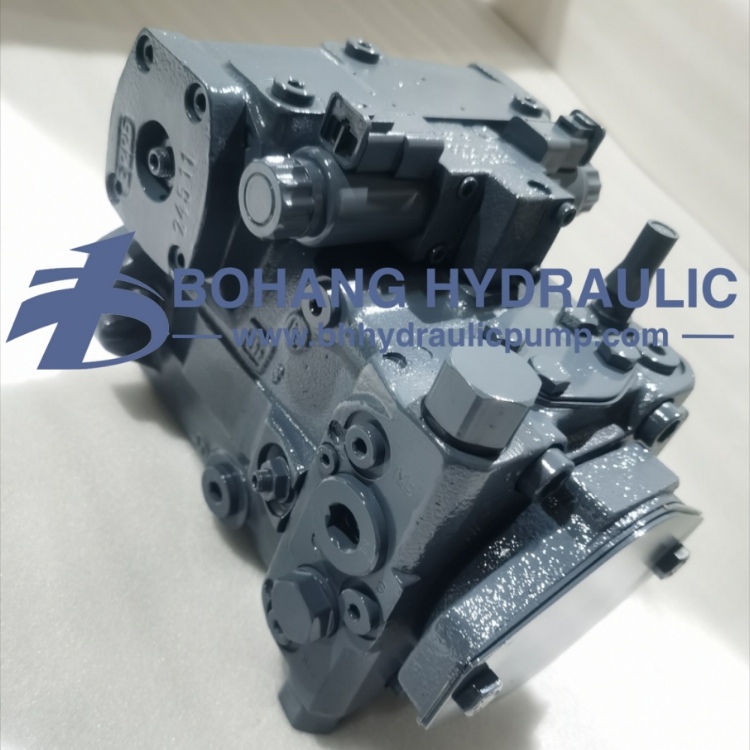
A hydraulic drive converts mechanical input into fluid power and then converts that fluid power into useful movement. An engine or electric motor turns a hydraulic pump, valves control the oil, and a hydraulic motor or cylinder moves the load. Understanding that path helps you do more than identify the parts: it shows what data to collect when a machine is slow, hot, weak, or ready for a replacement component.
How Does a Hydraulic Drive Work?
Most hydraulic drives follow four stages:
Power generation: An electric motor or internal-combustion engine turns a hydraulic pump. Rather than creating pressure on its own, the pump supplies flow. Pressure rises when that flow meets resistance from the load and circuit.
Control: Directional valves route oil to the required actuator port. Flow-control valves influence actuator speed, while pressure-control and relief valves limit or regulate pressure.
Actuation: A hydraulic motor converts fluid power into torque and rotary motion. A hydraulic cylinder produces linear force for lifting, pushing, pulling, or clamping.
Return and conditioning: Oil returns to a reservoir in an open circuit or circulates toward the pump in a closed circuit. Filters, coolers, and the reservoir help manage contamination, temperature, and air before reuse.
When examining an existing machine, trace this same route: pump, valves, actuator, and return path. That sequence identifies where pressure, flow, temperature, and component information should be collected before troubleshooting or replacing parts.
What Controls Force, Torque, and Speed?
Pressure and flow describe different parts of system performance. Confusing them often leads to incorrect diagnosis or an unsuitable replacement.
| Variable | Mainly affects | What it does not guarantee |
|---|---|---|
| Pressure | Cylinder force or motor torque | Actuator speed |
| Flow | Cylinder or motor speed | Adequate force or torque |
| Displacement | Oil volume per revolution and the torque-speed relationship | Correct system matching |
| Efficiency | Actual output, losses, and heat | Nameplate performance under every condition |
For a cylinder, available force depends mainly on pressure acting over piston area. For a hydraulic motor, torque depends mainly on pressure difference, displacement, and mechanical efficiency. Speed depends largely on the flow reaching the actuator relative to its displacement or effective area.
High pressure with slow movement therefore does not automatically mean that more pressure is needed. Restricted valves, insufficient pump flow, excessive load, internal leakage, or incorrect actuator displacement may all produce a slow response. Record pressure and speed together instead of judging the system from one gauge reading.
Main Components and What to Check
Every component changes, controls, or carries energy. Use the table below to decide what information matters first.
| Component | Main job | First details to check |
|---|---|---|
| Hydraulic pump | Supplies oil flow | Model, displacement, drive speed, rotation, pressure rating |
| Hydraulic valves | Control direction, flow, and pressure | Valve function, flow capacity, pressure rating, spool or control type |
| Hydraulic motor | Produces rotary motion | Displacement, pressure difference, flow, speed, case-drain requirements |
| Hydraulic cylinder | Produces linear motion | Bore, rod, stroke, mounting, pressure |
| Reservoir and filter | Store and condition oil | Capacity, fluid level, filtration, breather, return arrangement |
| Hose or manifold | Carry oil between components | Pressure rating, internal size, ports, material compatibility |
Choose a motor when the load requires rotation, such as a travel drive, conveyor, winch, or fan. Choose a cylinder when the task requires straight-line lifting, pushing, clamping, or positioning. If motion type is unclear, define what the load must do before comparing part numbers.
Open-Circuit vs. Closed-Circuit Drives
In an open circuit, a pump draws oil from a reservoir and sends it through valves to a motor or cylinder. Used oil then returns to the reservoir, where heat, air, and contamination can be managed before recirculation. Multi-function mobile and industrial systems commonly use this arrangement.
A closed circuit routes most of the main flow directly between a pump and hydraulic motor. Reversing pump flow can reverse motor direction, making this arrangement useful for propulsion and other bidirectional rotary drives. Closed circuits still need supporting provisions such as charge oil, filtration, cooling, and case-drain flow; "closed" does not mean isolated or maintenance-free.
Hydrostatic drive usually describes a hydraulic transmission that transfers power through fluid pressure using positive-displacement pumps and motors. It fits within the broader hydraulic-drive category. Before replacing a pump or motor, confirm whether the machine uses an open or closed circuit, because similar mounting dimensions do not establish circuit compatibility.
Where Hydraulic Drives Make Sense
Hydraulic drives are useful when a machine needs substantial force or torque from compact components, flexible placement between the power source and actuator, or adjustable motion under changing loads.
| Machine task | Typical actuator | Important operating requirement |
|---|---|---|
| Excavator travel or swing | Hydraulic motor | Torque, speed, direction, braking |
| Boom or bucket movement | Hydraulic cylinder | Force, travel speed, load holding |
| Conveyor or winch | Hydraulic motor | Continuous torque, speed, braking |
| Industrial pressing or clamping | Hydraulic cylinder | Force, stroke, repeatability |
Relevant applications include construction machinery, agricultural machinery, material-handling equipment, and industrial machines. Suitability still depends on duty cycle, control needs, maintenance capability, environment, and expected efficiency.
Benefits such as controllable force, flexible routing, and compact actuators come with tradeoffs. Leakage, fluid contamination, pressure loss, friction, and throttling can reduce performance or generate heat. Systems also require suitable filtration, fluid care, temperature control, and inspection. Applications that prioritize cleanliness, simple maintenance, or long periods at one steady operating point may justify comparing hydraulic, electric, and mechanical options before deciding.
Common Misconceptions and Warning Symptoms
Several assumptions can send a maintenance or purchasing decision in the wrong direction:
More pressure will make the actuator faster: Speed depends primarily on available flow relative to actuator size or displacement.
A pump and motor are interchangeable: Sealing, bearing loads, inlet conditions, case pressure, lubrication, and port design may differ.
Matching the flange is enough: Displacement, shaft, rotation, pressure, speed, ports, controls, and circuit type must also match.
A closed circuit needs no cooling or filtration: Supporting oil-conditioning arrangements remain necessary.
Use operating symptoms as clue:
| Symptom | Possible system-level direction | Useful next step |
|---|---|---|
| Slow movement | Low effective flow, restriction, internal leakage, overload | Record speed, pressure, oil temperature, and load |
| Low force or torque | Insufficient pressure difference, leakage, wrong displacement | Compare inlet/outlet pressure and component data |
| Overheating | Throttling loss, internal leakage, low oil, poor cooling | Check temperature, oil level, filter, and cooler condition |
| Unusual noise | Inlet restriction, aeration, contamination, mechanical wear | Note when noise occurs and consult the machine manual |
| External leakage | Seal, hose, fitting, or housing damage | Isolate stored pressure and arrange qualified inspection |
Never loosen a pressurized connection, bypass a relief or load-holding valve, or change a pressure setting solely from a general article. Equipment manuals and qualified technicians should govern safety-critical testing and repair. For broader system diagnosis, see the complete guide to hydraulic components, circuits, and operation.
What to Prepare Before Selecting a Replacement
Start with the existing component rather than a visually similar product. Photograph the complete nameplate and record the manufacturer, model, displacement, shaft, flange, rotation direction, and port arrangement. A clear hydraulic schematic is more useful than exterior photos alone.
Next, document operating requirements:
- continuous and peak pressure;
- required flow;
- motor speed and torque, or cylinder force and travel speed;
- duty cycle and load pattern;
- hydraulic fluid and expected temperature range;
- open- or closed-circuit configuration;
- fixed- or variable-displacement control;
- case drain, braking, and load-holding requirements.
Compare these conditions with the applicable data sheet for the exact series, size, and control option. Do not use one model's rating to represent an entire product family, and do not assume that matching pressure alone establishes compatibility.
If information is missing, avoid guessing. Ask the machine manufacturer or a hydraulic specialist to identify the circuit and required performance. To discuss a pump, motor, or valve requirement with Bohang, send the model number, nameplate photo, circuit type, and operating conditions.
FAQ
Q1. Does a hydraulic pump create pressure or flow?
A: A pump supplies flow. Pressure develops as that flow encounters resistance from the load and circuit. Pump and system pressure ratings still determine the allowable operating range.
Q2. What controls hydraulic motor speed?
A: Available flow, motor displacement, and volumetric efficiency mainly determine speed. Restrictions, leakage, and insufficient pump delivery can reduce actual rpm.
Q3. What controls hydraulic motor torque?
A: Pressure difference across the motor, displacement, and mechanical efficiency mainly determine torque. More inlet pressure does not help if outlet back pressure rises by a similar amount.
Q4. Why can a machine show high pressure but move slowly?
A: High pressure may show that the system is meeting heavy resistance. Low flow, a restricted valve, internal leakage, overload, or incorrect displacement may still limit movement.
Q5. What should I send when requesting a replacement?
A: Provide the full model code, nameplate photo, circuit type, displacement, pressure, flow, speed, shaft, flange, ports, rotation, fluid, and application. Include a schematic whenever available.
Conclusion
Hydraulic drives work by converting mechanical input into controlled fluid power and then back into rotary or linear motion. A hydraulic pump supplies flow, system resistance creates pressure, and hydraulic valves regulate direction, flow, and maximum pressure. Hydraulic motors produce torque and rotation, while cylinders provide pushing, pulling, or lifting force.
Before selecting a replacement, identify the circuit type and record the model, displacement, pressure, flow, speed, shaft, flange, ports, fluid, and operating conditions. Use complete data, not appearance. Explore Bohang hydraulic pumps, motors, and valves, or send your nameplate and system data to Bohang for a component review and quote.