
Choosing a hydraulic motor is not only a matter of finding a motor with a large pressure rating. The motor must match the load, speed, available flow, pressure difference, duty cycle and mechanical connection. A poor match can produce slow movement, excess heat, unstable control or repeated seal and bearing failures.
What Is a Hydraulic Motor?
A hydraulic motor converts fluid pressure and flow into rotational mechanical power. Pressure difference across the motor creates torque. Flow entering the motor determines how quickly the shaft turns. Motor displacement links these two values by defining how much fluid is required for one shaft revolution.
The pressure shown at the pump outlet is not always the pressure available at the motor. Hose, valve and return line losses reduce the effective pressure difference. For sizing, use the pressure on the motor inlet side minus the pressure on the outlet side.
A pump and a motor perform opposite energy conversions, but they are not automatically interchangeable. A motor must tolerate the pressure conditions on both ports, the required direction of rotation and any case drain requirements in the circuit.
Main Types of Hydraulic Motors
Gear Motors
Gear motors use meshing gears to convert fluid energy into rotation. They are compact, simple and suitable for many moderate speed applications such as conveyors, fans and agricultural equipment.
Before selecting one, check continuous pressure, starting torque, minimum speed and noise. A gear motor may not provide the low speed control needed by a heavy winch.
Vane Motors
Vane motors use a rotor and sliding vanes inside an eccentric housing. They can provide smooth, quiet output in industrial machines and moderate duty drives when pressure, speed and oil cleanliness remain within the rated range.
Orbital, Gerotor and Geroler Motors
Orbital motors use an internal gear arrangement to produce rotation. They are commonly considered for low speed, high torque work such as augers, conveyors, wheel drives and selected winch applications. The terms gerotor and geroler are used for different internal designs, so the exact displacement, pressure, speed and efficiency must be taken from the model data sheet.
Piston Motors
Piston motors are chosen when pressure, efficiency, power density or control range is important. Axial piston motors include swash plate and bent axis designs. Radial piston motors are considered for very low speed, high starting torque and heavy direct drive applications.
Variable displacement piston motors can change the torque and speed relationship while the machine is operating. This is useful in hydrostatic travel drives and equipment that must move between a high torque working mode and a higher speed travel mode. Control pressure, minimum displacement and overspeed protection must be checked before installation.
A Practical Type Comparison
| Motor type | Typical operating profile | Main benefit | Important check |
|---|---|---|---|
| Gear | Moderate speed and torque | Simple and compact | Continuous pressure and low speed smoothness |
| Vane | Moderate pressure and smooth rotation | Quiet and stable operation | Oil cleanliness and wear condition |
| Orbital | Low speed and high torque | Compact LSHT drive | Starting torque and maximum speed |
| Axial or bent axis piston | High pressure and high power density | Efficiency and control range | Control type, case pressure and duty cycle |
| Radial piston | Very low speed and high torque | Direct heavy load drive | Size, shaft load and shock loading |
These are selection directions, not universal performance limits. The final choice must be checked against the manufacturer data sheet and the actual operating cycle.
Hydraulic Motor Sizing: Torque, Speed and Power
Start with the load rather than the motor catalogue. Record continuous and starting torque, target speed, acceleration time, operating cycle, direction changes and external shaft loads.
When pressure is in bar, displacement is in cm³ per revolution and flow is in litres per minute, the following estimates are useful:
Actual torque: T ≈ Δp × D × ηm ÷ 20π
Actual speed: n ≈ 1000 × Q × ηv ÷ D
Hydraulic power: Ph = Δp × Q ÷ 600
Mechanical output power: Pout ≈ T × n ÷ 9549
Here, T is torque in Nm, Δp is the pressure difference in bar, D is displacement in cm³ per revolution, Q is flow in litres per minute, n is speed in rpm, ηm is mechanical efficiency and ηv is volumetric efficiency.
Worked Sizing Example
Assume a conveyor drive requires 1000 Nm of continuous torque. The measured pressure difference at the motor is 200 bar and the estimated mechanical efficiency is 0.90.
Required displacement: D = 20π × 1000 ÷ (200 × 0.90) ≈ 349 cm³ per revolution
A standard motor close to 350 cm³ per revolution can be considered for the next review. If available flow is 100 litres per minute and volumetric efficiency is 0.95: n ≈ 1000 × 100 × 0.95 ÷ 350 ≈ 271 rpm
The estimated torque is about 1003 Nm and the mechanical output is about 28.5 kW. This is a design example, not a model recommendation. The motor still needs to pass continuous pressure, peak load, speed, temperature, bearing load and interface checks.
Increasing displacement generally increases torque and reduces speed at the same flow. Increasing flow increases speed. Increasing pressure difference increases torque, but also heat and component stress. Do not raise pressure to compensate for an incorrectly sized motor.
How to Choose the Right Hydraulic Motor
Use this sequence before requesting a quotation:
1. Define the continuous and peak load.
2. Measure or estimate the pressure difference at the motor.
3. Confirm available flow at the required operating point.
4. Calculate a preliminary displacement and speed.
5. Select the motor family according to speed, torque, control and duty cycle.
6. Check the pump, valve, brake, gearbox and cooling arrangement as a system.
7. Verify the mechanical connection and the model performance data.
Application Examples
Construction Machinery
Excavator travel and swing drives require high torque and controlled speed under changing loads. Variable axial piston motors are often considered for hydrostatic travel systems. Concrete mixers and road rollers also need good starting performance. Verify shock loading, control response, cooling and case pressure.
Agriculture and Material Handling
Augers, conveyors, harvesters and wheel drives may operate at low or moderate speed for long periods. Orbital or gear motors can be starting points, but the final choice depends on torque, contamination, temperature and duty cycle. Intermittent ratings should not be treated as continuous ratings.
Industrial, Marine and Mining Equipment
Industrial mixers, cranes, winches and marine drives may combine high starting torque with inertia or shock loads. Bent axis or radial piston motors can be considered when power density and load control are important. Include load data, brake requirements, corrosion conditions, fluid and service interval in the quotation.
Bohang Hydraulic Motors for Replacement and OEM Applications
Selecting a hydraulic motor requires more than matching displacement. Pressure differential affects torque, flow determines speed, and the mounting interface decides whether the motor can be installed without modifying the machine. For buyers comparing hydraulic motor manufacturers, these details are often more important than a general product description.
Bohang Hydraulic focuses on fixed and variable bent axis axial piston motors, selected replacement models, and custom hydraulic motor solutions. This makes Bohang a practical option for mobile equipment, industrial drives, marine machinery and OEM projects that require verified pressure, torque, mounting and control specifications. Explore the Bohang hydraulic motor range to compare available product series.
| Project requirement | Suitable Bohang starting point | Main details to confirm |
| Fixed displacement and high pressure drive | A2FM fixed axial piston motor | Displacement, working pressure, speed, shaft, flange and ports |
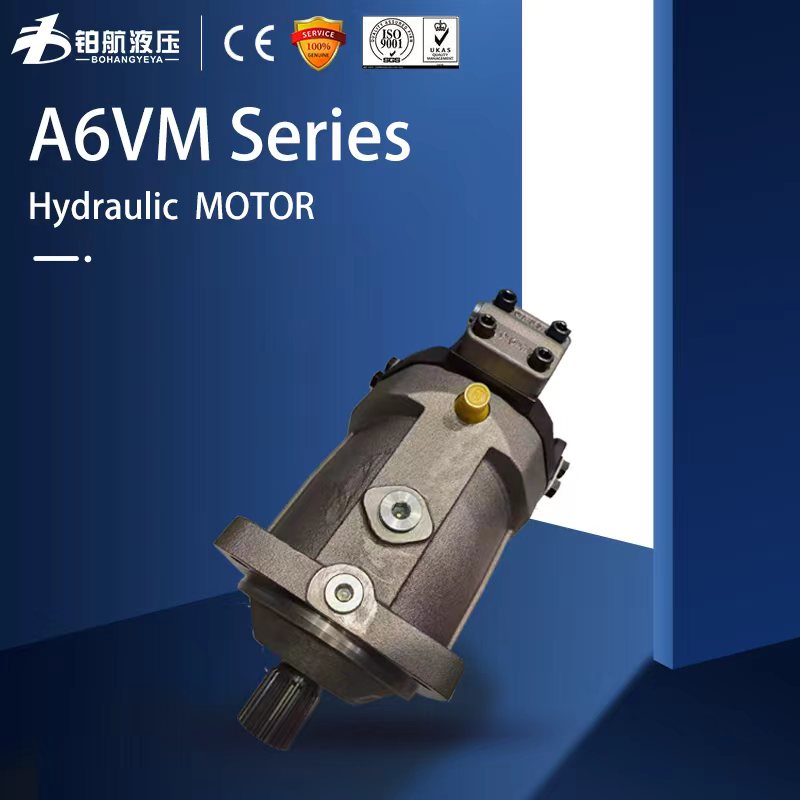
| Variable speed and torque control | A6VM variable axial piston motor | Control type, minimum displacement, case drain, boost and flushing requirements |
| Replacement for an existing motor | Bohang replacement motor range | Nameplate data, mounting interface, shaft or spline, port position and operating limits |
| Non standard OEM equipment | Custom hydraulic motor solution | Required torque, speed, pressure, flow, duty cycle and control performance |
Information to send for a technical review
Prepare the following details before requesting a quotation:
- Existing motor model or nameplate photo
- Required torque and rotational speed
- Working pressure and peak pressure
- Pump flow in L/min
- Mounting flange, shaft or spline and port dimensions
- Case drain requirements and rotation direction
- Machine type, duty cycle and operating environment
Contact Bohang Hydraulic for a motor selection and fitment review.
What to Send for a Hydraulic Motor Quote
To shorten technical review, send the motor nameplate, equipment model, torque, target rpm, working and peak pressure, flow, duty cycle, fluid, temperature, rotation, mounting drawing and shaft details. For replacement, include photos of the flange, shaft, ports and installation.
A complete request helps the supplier recommend a standard unit or identify where a custom configuration is needed. It reduces the risk of a motor that fits physically but misses the required speed or starting torque.
FAQ
Q1. Can a larger displacement motor solve low torque?
A: It can increase torque at the same pressure, but it also requires more flow for the same speed. Confirm pump capacity and available space first.
Q2. Is maximum pressure the normal working pressure?
A: No. Separate nominal, continuous, intermittent and peak pressure ratings.
Q3. Can two motors with the same displacement replace each other?
A: Not without checking interfaces, control, shaft loads, case pressure, rotation and duty cycle.
Q4. What is the most important sizing input?
A: The load profile is the starting point. Continuous torque, starting torque and speed should be evaluated together with pressure difference and flow.
For help selecting a fixed or variable displacement hydraulic motor, send your operating conditions and installation details to Bohang Hydraulic for a technical review.