
Choosing the right hydraulic pump is one of the most important decisions for keeping heavy equipment productive, efficient, and reliable. A hydraulic pump is not just another spare part. It is the component that creates hydraulic flow, drives actuators, supports lifting and digging power, and affects the speed, stability, temperature, and service life of the entire hydraulic system.
For equipment owners, repair shops, OEM buyers, and parts distributors, the challenge is usually not simply finding “a pump that looks similar.” The real challenge is choosing a hydraulic pump that matches the machine, hydraulic circuit, pressure requirements, flow demand, mounting dimensions, shaft configuration, fluid type, working environment, and long-term maintenance expectations.
Quick Answer: How Do You Choose the Right Hydraulic Pump?
To choose the right hydraulic pump, identify the machine model, hydraulic system type, pump part number, flow rate, pressure rating, displacement, rotation direction, shaft type, port size, mounting flange, control type, hydraulic fluid, and operating environment. For replacement pumps, always compare the old pump nameplate, equipment serial number, installation dimensions, and system requirements before ordering.
A reliable hydraulic pump selection process should answer these questions:
- What machine or system will the pump be used on?
- Is the pump for an open circuit or closed circuit?
- What flow rate does the system need?
- What working pressure and peak pressure must the pump handle?
- Is the original pump fixed displacement or variable displacement?
- What are the shaft, flange, port, and rotation requirements?
- What hydraulic oil and temperature range will the pump operate in?
- Is OEM, aftermarket, rebuilt, or custom manufacturing the best option?
If you are replacing a pump on heavy equipment, send the old pump nameplate, machine model, serial number, and photos of the pump installation to the supplier before purchase. This simple step can prevent costly mismatch, downtime, and repeated failure.
What Is a Hydraulic Pump?
A hydraulic pump is a mechanical device that converts mechanical energy into hydraulic energy by moving hydraulic fluid through a system. In simple terms, the pump creates flow. When that flow meets resistance from a load, the hydraulic system builds pressure.
The pump itself does not “create force” alone. It supplies the fluid flow that allows cylinders, motors, valves, and actuators to do work. This is why pump performance directly affects:
- Machine movement speed
- Lifting, pushing, digging, or steering power
- System response time
- Energy efficiency
- Oil temperature
- Noise and vibration
- Component service life
- Overall equipment uptime
In heavy equipment, hydraulic pumps are commonly used in excavators, loaders, bulldozers, cranes, forklifts, agricultural machinery, mining equipment, marine systems, municipal vehicles, and industrial machinery.
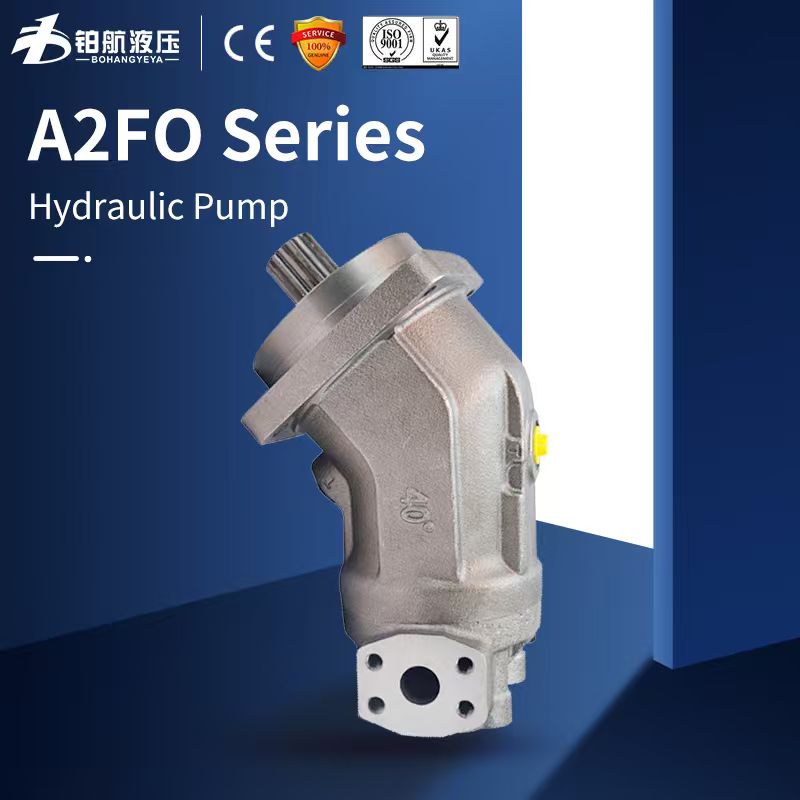
A2FO Series | Fixed Displacement Axial Piston Pump
Main Types of Hydraulic Pumps
Most heavy equipment hydraulic systems use one of three common pump types: gear pumps, vane pumps, or piston pumps. Each type has different advantages, limitations, and best-use scenarios.
1. Gear Pumps
Gear pumps use meshing gears to move hydraulic oil from the inlet side to the outlet side. They are simple, compact, durable, and cost-effective.
Best for:
- Agricultural machinery
- Forklifts
- Dump trucks
- Auxiliary circuits
- Steering systems
- Low-to-medium pressure applications
- Fixed-flow hydraulic systems
Advantages:
- Simple structure
- Lower cost
- Easy maintenance
- Good durability
- Compact design
- Suitable for many mobile hydraulic applications
Limitations:
- Usually fixed displacement
- Lower efficiency at high pressure compared with piston pumps
- Can be noisier than vane pumps
- Less suitable for highly precise or variable-flow systems
Gear pumps are often a practical choice when the system needs reliable fixed flow, moderate pressure, and cost-effective replacement.
2. Vane Pumps
Vane pumps use sliding vanes inside a rotor to create expanding and contracting chambers that move hydraulic fluid. They are known for smooth flow and relatively low noise.
Best for:
- Industrial equipment
- Machine tools
- Material handling equipment
- Hydraulic presses
- Systems requiring smooth, quiet operation
Advantages:
- Smooth output flow
- Lower noise
- Good efficiency in moderate-pressure systems
- Stable operation in clean oil conditions
Limitations:
- More sensitive to contamination
- Not always ideal for very high-pressure heavy-duty applications
- Requires good filtration and fluid maintenance
Vane pumps are a good option when smooth operation and lower noise matter, but the system must maintain clean hydraulic oil.
3. Piston Pumps
Piston pumps use reciprocating pistons to move hydraulic fluid. They are widely used in heavy-duty, high-pressure, and variable-flow systems.
Best for:
- Excavators
- Wheel loaders
- Drilling rigs
- Mining equipment
- Marine machinery
- Industrial presses
- High-pressure hydraulic systems
- Variable displacement systems
Advantages:
- High pressure capability
- High efficiency
- Suitable for variable displacement control
- Good performance in demanding applications
- Strong power density
- Longer service potential when properly maintained
Limitations:
- Higher purchase cost
- More complex structure
- Requires cleaner oil and better maintenance
- More demanding installation and commissioning requirements
For many modern heavy machines, especially excavators and large mobile equipment, axial piston pumps are often the preferred choice because they can handle high pressure and adjust flow according to system demand.
Key Specifications to Check Before Choosing a Hydraulic Pump
Before buying a hydraulic pump, do not rely only on the pump’s appearance or price. Two pumps may look similar but perform very differently once installed. The safest way is to check the basic specifications first, then confirm the mounting and connection details.
1. Flow Rate
Flow rate tells you how much hydraulic oil the pump can move. It is usually measured in GPM or L/min.
A pump with too little flow will make the machine slow. A pump with too much flow may create extra heat, waste power, and put more stress on valves and hoses.
For replacement pumps, match the original flow requirement unless the hydraulic system has been redesigned.
2. Pressure Rating
Pressure rating shows how much load the pump can handle. Always check both normal working pressure and maximum pressure.
Heavy equipment usually works under changing loads, so the pump must have enough pressure capacity for real job conditions, not just light operation.
Do not choose a pump only because the pressure rating is higher. The full system, including valves, hoses, seals, and cylinders, must also be able to handle it.
3. Displacement
Displacement means how much oil the pump delivers in one revolution. It is commonly shown as cc/rev or in³/rev.
This is one of the most important numbers when replacing a hydraulic pump. If the displacement is wrong, the machine may move too slowly, run too hot, or overload the power source.
4. Speed Range
Every pump has a recommended speed range. The pump speed must match the engine, electric motor, gearbox, or PTO that drives it.
Running a pump too fast may cause noise, heat, cavitation, and early wear. Running it too slow may not provide enough flow for the machine.
5. Rotation Direction
Hydraulic pumps may rotate clockwise or counterclockwise. Some models are reversible, but many are not.
If the rotation direction is wrong, the pump may not draw oil correctly and can be damaged soon after startup. Check the arrow on the pump body, the nameplate, or the service manual before installation.
6. Shaft, Ports, and Mounting
These details decide whether the pump can physically fit your machine.
Check the shaft type, spline count, shaft diameter, flange size, bolt pattern, pilot diameter, port size, thread type, and port position. For piston pumps, also confirm the case drain port.
Even if the flow and pressure are correct, a small difference in shaft or mounting dimensions can make the pump unusable.
7. Hydraulic Fluid Compatibility
The pump must work with the hydraulic oil used in the system. Check the oil type, viscosity grade, operating temperature, and seal compatibility.
Wrong oil or poor oil condition can lead to leakage, poor lubrication, cavitation, overheating, and faster internal wear.
8. Control Type
For simple gear pumps, this may not be complicated. For piston pumps and variable displacement pumps, control type is critical.
Confirm whether the pump uses pressure compensation, load sensing, hydraulic pilot control, electric control, or another control method. A pump that looks correct but has the wrong control type may not work properly on the machine.
OEM vs. Aftermarket vs. Rebuilt Hydraulic Pumps
When replacing a hydraulic pump, buyers usually compare OEM, aftermarket, rebuilt, remanufactured, and used options.
| Option | Advantages | Limitations |
|
| OEM Pump |
|
Higher cost, possible long lead time | Newer equipment, warranty-sensitive machines |
| Aftermarket Pump | Competitive price, faster availability, broad replacement coverage | Quality varies by manufacturer | Older machines, distributors, cost-sensitive fleets |
| Rebuilt Pump | Lower upfront cost, uses existing core | Depends heavily on rebuild quality | Minor wear or trusted repair programs |
| Remanufactured Pump | More complete restoration than basic repair | Still depends on testing standards | Buyers balancing cost and reliability |
| Used Pump | Low price, fast in emergencies | Unknown wear, limited reliability | Temporary emergency use only |
The cheapest pump is not always the lowest-cost solution. A poorly matched or poorly tested pump can lead to repeated downtime, oil contamination, damaged valves, overheated systems, and higher repair costs.
Common Mistakes When Choosing a Hydraulic Pump
1. Matching Only by Appearance:
Two hydraulic pumps may look almost identical but have different displacement, pressure rating, shaft type, rotation direction, control type, or internal configuration.
2. Ignoring the Machine Serial Number:
Heavy equipment models can change hydraulic components across production years. The machine serial number is often essential for correct identification.
3. Choosing a Larger Pump to “Improve Power”:
A bigger pump does not automatically make the machine stronger. It may increase heat, engine load, relief valve activity, and component stress.
4. Replacing the Pump Without Finding the Root Cause:
If the old pump failed because of contamination, cavitation, overheating, wrong oil, or clogged suction lines, the new pump may fail quickly too.
5. Ignoring Hydraulic Oil Cleanliness:
Hydraulic pumps, especially piston pumps and vane pumps, are sensitive to contamination. Dirty oil can damage precision surfaces, seals, bearings, pistons, vanes, and valve plates.
6. Forgetting Case Drain Requirements:
For many piston pumps and motors, the case drain line must be correctly installed and unrestricted. High case pressure can damage shaft seals and internal components.
7. Buying Without Technical Confirmation:
For heavy equipment replacement, always ask the supplier to verify the pump model, fitment, and specifications before shipment.
How to Know If Your Hydraulic Pump Needs Replacement
A hydraulic pump may need repair or replacement if you notice:
- Slow machine movement
- Weak lifting or digging power
- Abnormal whining, rattling, or knocking noise
- Hydraulic oil overheating
- Pressure loss
- Unstable actuator movement
- Excessive vibration
- Oil leakage around the shaft seal
- Metal particles in filters or oil
- Frequent filter clogging
- Repeated seal failure
- Pump performance loss after warm-up
However, these symptoms do not always mean the pump is the only problem. Check the entire system before replacing the pump. A clogged suction strainer, air leak, wrong oil viscosity, relief valve problem, blocked filter, worn cylinder, or contaminated reservoir can create symptoms similar to pump failure.
Hydraulic Pump Applications in Heavy Equipment
1. Excavators: Excavators often use high-performance variable displacement axial piston pumps for main hydraulic functions. These pumps support boom, arm, bucket, swing, travel, and attachment circuits.
2. Wheel Loaders: Wheel loaders may use hydraulic pumps for steering, implement movement, fan drive, brake charging, and auxiliary functions.
3. Bulldozers: Bulldozers require durable hydraulic pumps for blade control, steering, and powertrain-related hydraulic functions.
4. Forklifts: Forklifts commonly rely on hydraulic pumps for lift, tilt, steering, and attachments.
5. Agricultural Machinery: Tractors, harvesters, sprayers, and loaders use hydraulic pumps for steering, lifting, implements, and auxiliary circuits.
6. Mining Equipment: Mining machines need pumps that can handle high load, long duty cycles, contamination risk, and harsh operating environments.
7. Marine and Industrial Equipment: Hydraulic pumps are used in winches, deck machinery, presses, power units, production equipment, and heavy-duty drive systems.
Why Work With a Professional Hydraulic Pump Manufacturer?
Choosing the right hydraulic pump is easier when you work with a manufacturer that understands both product specifications and real-world machine applications.
A professional hydraulic pump manufacturer should provide:
- Product model identification
- Cross-reference support
- Engineering consultation
- Standard and custom pump options
- Quality inspection
- Pressure and flow testing
- Replacement pump matching
- Technical documentation
- After-sales support
- Stable supply for distributors and OEM buyers
Bohang Hydraulic supplies hydraulic pumps, hydraulic motors, hydraulic valves, piston pump spare parts, piston motor spare parts, and custom hydraulic solutions for mobile and industrial applications. For buyers looking for replacement hydraulic pumps, Bohang can help review pump model codes, equipment requirements, installation dimensions, and working conditions before quotation.
Conclusion
Choosing the right hydraulic pump comes down to matching the pump to the machine, not just the price or appearance. Check the pump type, flow, pressure, displacement, rotation, shaft, ports, mounting, oil compatibility, and control method before ordering. If it is a replacement pump, confirm the old pump code and machine serial number first. A correctly selected pump helps heavy equipment run faster, cooler, safer, and longer, while reducing downtime and repair costs.
FAQ
Q1. How do I know which hydraulic pump I need?
A: Start with the machine model, serial number, old pump part number, flow rate, pressure rating, displacement, shaft type, rotation direction, ports, and mounting size. If it is a replacement pump, clear photos of the nameplate and installation position can help the supplier confirm the correct model.
Q2. What are the signs of a failing hydraulic pump?
A: Common signs include slow movement, weak lifting power, unusual noise, overheating oil, pressure loss, vibration, leakage, and metal particles in the oil or filter. These symptoms should be checked early to avoid bigger system damage.
Q3. Can I replace a hydraulic pump with a larger one?
A: Usually not. A larger pump may increase heat, fuel consumption, pressure spikes, and stress on valves, hoses, seals, and cylinders. Only use a larger pump if the hydraulic system is designed or adjusted for it.
Q4. What happens if a hydraulic pump rotates the wrong way?
A: Wrong rotation can cause poor oil suction, low flow, noise, seal damage, overheating, or early pump failure. Always confirm the rotation direction from the pump arrow, nameplate, service manual, or supplier before installation.
Q5. Should I repair or replace my hydraulic pump?
A: Repair may work for minor seal leaks or light wear. Replacement is usually better when the pump has serious internal damage, repeated failures, low efficiency, metal contamination, or when downtime costs are higher than the repair savings.
Q6. Why does a new hydraulic pump fail quickly?
A: A new pump can fail quickly if the original problem was not fixed. Common causes include dirty oil, cavitation, wrong rotation, dry start, blocked suction line, incorrect oil viscosity, high case drain pressure, or poor installation.