

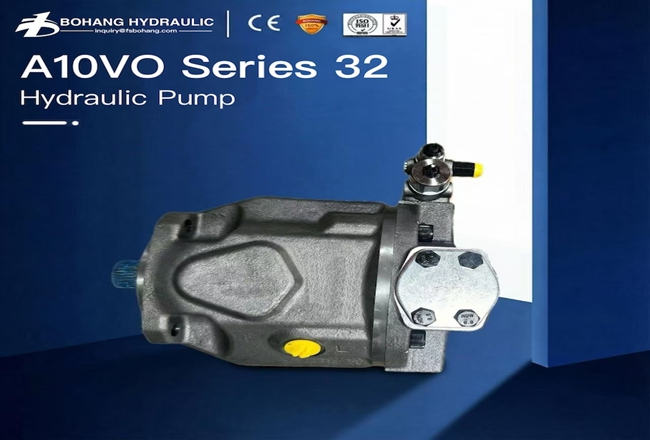
A10VO and A10VSO are variable displacement axial piston pumps for open-circuit hydraulic systems. The letters alone should not be used as the final replacement decision. The application, series, size, control, shaft, flange, ports, rotation, speed range, and pressure duty must also match.
The practical distinction is that A10VO is commonly selected for mobile equipment, while A10VSO is commonly associated with stationary industrial equipment. That distinction is useful at the first screening stage, but it is not a substitute for checking the complete model code.
A pump that fits the mounting face can still respond incorrectly, run outside its speed range, or fail to control pressure as the machine requires.
What the two pump families have in common
Both families use a swashplate axial piston design. Flow changes when the swashplate angle changes, and the theoretical flow is related to displacement and shaft speed: Q = Vg × n × ηv / 1000
where Q is flow in litres per minute, Vg is displacement in cubic centimetres per revolution, n is speed in revolutions per minute, and ηv is volumetric efficiency expressed as a decimal. The formula is useful for checking whether a proposed pump can support the required actuator speed.
It does not replace the manufacturer's performance curves.
Bohang lists its A10VO range with displacements from 18 to 140 cm³/rev, a nominal pressure of 280 bar, and a maximum pressure of 350 bar. The product information also identifies open-circuit operation, variable displacement, two case drain ports, multiple controller options, and through-drive capability.
These figures are application data, not permission to operate continuously at the maximum value.
Where the application difference matters
Mobile machines often experience changing engine speed, shock loads, vibration, limited installation space, and frequent changes in demand. A mobile pump selection therefore needs attention to the drive speed range, suction conditions, control response, shaft loading, and the machine's available power.
Stationary industrial equipment may operate for long periods at a narrower speed range, but it can place a different demand on pressure stability, noise, heat rejection, control accuracy, and continuous duty.
A pump selected for a mobile machine should not be moved into a press or test bench application simply because the size and flange appear similar.
The control is an important difference in practice. Pressure compensation, load sensing, power control, electrical proportional control, and other options change how the pump reacts to the circuit.
If the old pump uses a load-sensing controller and the replacement has a different control logic, the machine may run slowly, consume more power, or remain at high standby pressure.
Comparison table
|
Check |
A10VO screening point |
A10VSO screening point |
Why it matters |
|
Typical application |
Mobile machinery |
Stationary industrial equipment |
Duty cycle and control response differ |
|
Circuit |
Open circuit |
Open circuit |
Tank return and inlet arrangement must match |
|
Displacement range |
Bohang lists 18 to 140 cm³/rev |
Confirm the exact supplier series and size |
Size is not enough without series and version |
|
Nominal pressure |
Bohang lists 280 bar |
Confirm the exact nameplate and data sheet |
Pressure rating is not a flow rating |
|
Maximum pressure |
Bohang lists 350 bar |
Confirm the exact nameplate and data sheet |
Peak pressure duration and frequency matter |
|
Control |
DFR, DR, and other variants may be available |
Control suffix must be matched |
Incorrect control creates unstable operation |
|
Drive speed |
Match engine or motor speed and direction |
Match electric motor speed and duty |
Overspeed can damage the rotating group |
|
Mounting and ports |
Check SAE or ISO interface, shaft, and ports |
Check the complete interface |
A bolted fit does not prove hydraulic compatibility |
Six model-code checks before approving a replacement
- Record the full code. Photograph the nameplate, casting marks, controller, shaft end, and port side. A partial family name is not enough.
- Confirm the circuit. Verify that the pump works in an open circuit and note the reservoir, inlet line, return filtration, and case drain arrangement.
- Match the displacement. A larger displacement may overload the prime mover or make the system too fast. A smaller displacement may reduce actuator speed and increase heat from extended operation.
- Match the control. Record the control type, pressure setting, load-sensing differential, pilot connections, and electrical voltage if fitted.
- Check interfaces. Compare flange pattern, shaft spline, rotation, port thread or flange, port orientation, and case drain location.
- Compare operating data. Collect actual pressure, flow, speed, oil temperature, and duty cycle. The machine’s real values are more useful than a catalogue headline.
Two application examples
For a mobile loader, the first questions are engine speed, standby behaviour, load-sensing response, suction line condition, and available installation space. A pump that reaches the required 280 bar but has the wrong control setting may hold the engine under unnecessary load.
For a stationary forming machine, continuous pressure duty, repeatability, oil temperature, noise, and control integration deserve more attention. A replacement should be checked at the machine’s normal cycle, not only at a brief no-load start.
Match the pump to the power available
Flow and pressure also determine input power. A useful screening formula is:
P input (kW) = Q (L/min) × Δp (bar) / (600 × ηtotal)
where ηtotal is the estimated total efficiency. For example, 107 L/min at 280 bar gives about 49.9 kW of hydraulic power. At 90% total efficiency, the estimated input is about 55.5 kW. The prime mover must supply more than the ideal hydraulic-power value, and the real duty cycle matters.
The control should be checked against the power curve, not just the pressure setting. A pressure compensator limits pressure, while a load-sensing control can reduce standby demand when the machine is not calling for flow. A torque or power control may be needed when engine power is limited.
The right choice depends on the circuit and the control signal available at the machine, not on the family name printed on the housing.
Also confirm the required standby pressure and response time. These two values often explain why a pump that reaches the correct peak pressure still feels wrong in service.
What a buyer should include in the inquiry
An efficient inquiry contains the complete pump code, machine model, application, operating hours, oil grade, normal and peak pressure, required flow, drive speed, rotation, control signal, mounting photos, and the reason for replacement.
If the old unit failed, include oil analysis, filter condition, case drain observations, and any metal found in the circuit.
This information allows the supplier to separate three different jobs: a direct replacement, a compatible alternative with a setting change, or a redesign that needs engineering approval.
That distinction makes the quotation clearer and reduces the risk of an apparently low price becoming a costly installation correction.
Use the application as the final filter
A code comparison is more reliable when it is checked against the job the machine must perform. List the functions that need simultaneous flow, the longest continuous working period, the expected pressure at each function, and the amount of time the pump spends in standby.
A crane, loader, press, and power unit may all use variable piston pumps, yet their control response and heat load can be very different.
Pay attention to the inlet side. A pump with a suitable catalogue speed can still suffer if the suction line is too small, too long, or exposed to excessive temperature. Check reservoir height, inlet fittings, oil level, and the condition of the suction hose before deciding that a different pump family is required.
This also gives the buyer a better commissioning plan for the replacement.
Common mistakes
A common mistake is treating the "S" in A10VSO as the only selection rule. Another is ordering by displacement alone. Buyers also overlook the controller, assume a similar-looking flange confirms interchangeability, or copy a maximum pressure value into the normal working pressure field.
Do not adjust a compensator before confirming the pressure gauges, relief valve, oil condition, and load-sensing signal. A control adjustment can hide a circuit fault and make later diagnosis harder.
FAQ
Q1. Can an A10VO replace an A10VSO?
A: Sometimes, but only after the complete code, interfaces, controls, speed, pressure, and duty cycle are compared. Family names are not enough.
Q2. Are A10VO and A10VSO both open-circuit pumps?
A: Yes, both families are associated with open-circuit variable axial piston pump designs, but the exact series and control configuration still need confirmation.
Q3. Does the higher pressure value mean better performance?
A: No. Pressure, flow, speed, efficiency, heat rejection, and control stability must be considered together.
Q4. What should I send for a replacement quotation?
A: Send the full nameplate code, clear photos, machine application, rotation, required flow and pressure, drive speed, oil type, and any known control settings.
Next step
If the old pump is difficult to identify, send Bohang Hydraulic the nameplate photo and operating data before ordering.
Compare the A10VO Series 31 variable pump, browse the Hydraulic Pump category, or discuss a Custom Solution.
The contact team can classify the request as a direct replacement, controlled configuration change, or custom project.
Conclusion
A10VO is generally selected for mobile duty, while A10VSO is used for stationary industrial service, but that distinction does not prove interchangeability. The correct pump must match the complete series and model code, displacement, control, rotation, shaft, flange, ports, speed, pressure and oil conditions.
Before approving a replacement, compare the nameplate with the machine's measured duty and available input power. Bohang can then confirm whether the request is a direct replacement, a controlled configuration change or a custom solution.