
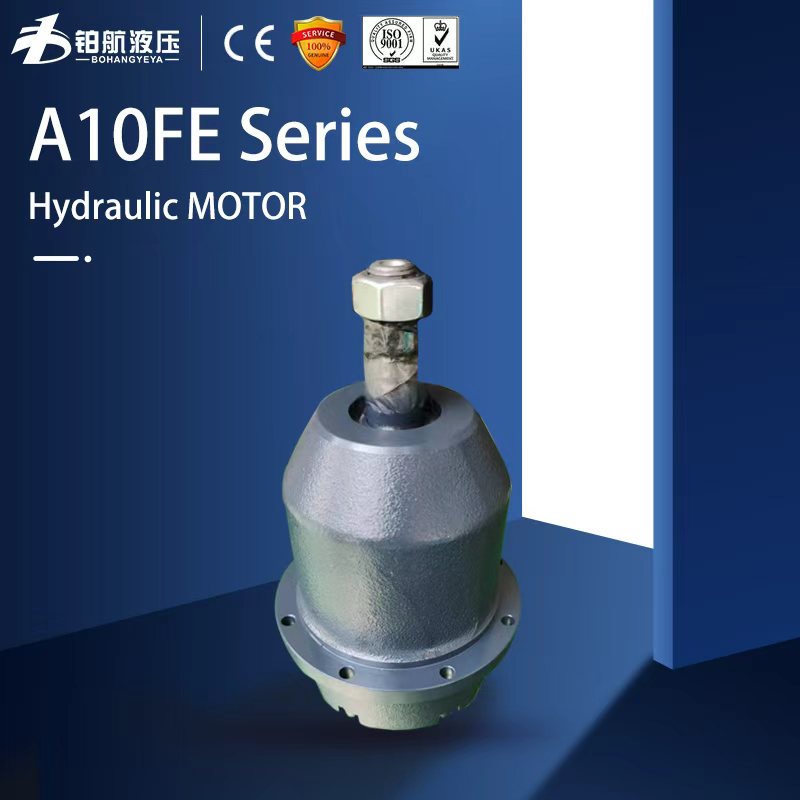
A10FE Series 52 Replacement Axial Piston Fixed Motor is a compact hydraulic piston motor developed for reliable power transmission in open- and closed-circuit hydrostatic drives. Built with proven A10 swashplate rotary group technology, it delivers stable rotary output, low operating noise and dependable service in mobile and industrial equipment. Its plug-in construction makes it especially suitable for gearbox integration and space-limited drive arrangements. For hydraulic systems that do not require variable displacement, the A10FE provides a practical replacement option among high-speed piston motors.
1. Predictable fixed-displacement output: Motor speed changes in proportion to inlet flow, while output torque increases with the pressure differential between the high- and low-pressure sides.
2. Wide displacement selection: Eleven sizes are available, covering displacements from 10.6 to 63.1 cm³/rev for matching different flow, speed and torque requirements.
3. High-pressure and high-speed operation: All listed sizes support a nominal pressure of 280 bar and a maximum pressure of 350 bar, with maximum speeds ranging from 3,400 to 5,000 rpm.
4. Space-saving plug-in design: The compact housing is designed for installation in mechanical gearboxes and other drive systems where conventional external motor mounting may take up too much space.
FAQ
Q1. What is an axial piston fixed motor?
An axial piston fixed motor is a hydraulic motor that converts pressurized fluid into continuous rotary motion. Its pistons are arranged parallel to the drive shaft and operate through a swashplate or bent-axis rotary group. Because the displacement remains constant, the motor provides a predictable relationship between hydraulic flow, rotational speed and output torque.
Q2. How does an axial piston fixed motor work?
Pressurized oil enters the motor and acts on a circular group of pistons. The piston movement is transferred through a swashplate or bent-axis mechanism, causing the cylinder block and output shaft to rotate. Oil flow mainly determines motor speed, while the pressure difference between the inlet and outlet determines the available torque.
Q3. What is the difference between fixed and variable displacement piston motors?
A fixed-displacement motor uses the same oil volume for each shaft revolution, so speed is normally adjusted by changing the incoming flow. A variable-displacement motor can change its internal displacement, allowing a wider range of speed and torque control. Fixed piston motors are generally preferred when the operating range is stable and a simpler drive configuration is required.
Q4. How do I choose the correct displacement for an axial piston motor?
Start with the required motor speed, available pump flow, operating pressure and load torque. At the same flow rate, a larger displacement produces a lower shaft speed. At the same pressure differential, a larger displacement produces more theoretical torque. Starting torque, continuous duty, peak load and efficiency losses should also be included when sizing the motor.
Q5. What should be checked when selecting a replacement axial piston fixed motor?
Do not select a replacement by displacement alone. Confirm the complete identification code, displacement, mounting flange, shaft dimensions, rotation direction, working-port size and position, case-drain arrangement, seal material and optional valves or sensors. Installation dimensions and operating limits should be compared with the existing motor before an order is placed.
Q6. Can an axial piston fixed motor operate in both open- and closed-loop systems?
Some axial piston fixed motors are suitable for both open- and closed-circuit hydrostatic drives, while others are designed for only one circuit type. The product datasheet should be checked for circuit compatibility, permissible back pressure, minimum inlet pressure, flushing requirements and case-drain limits before installation.