
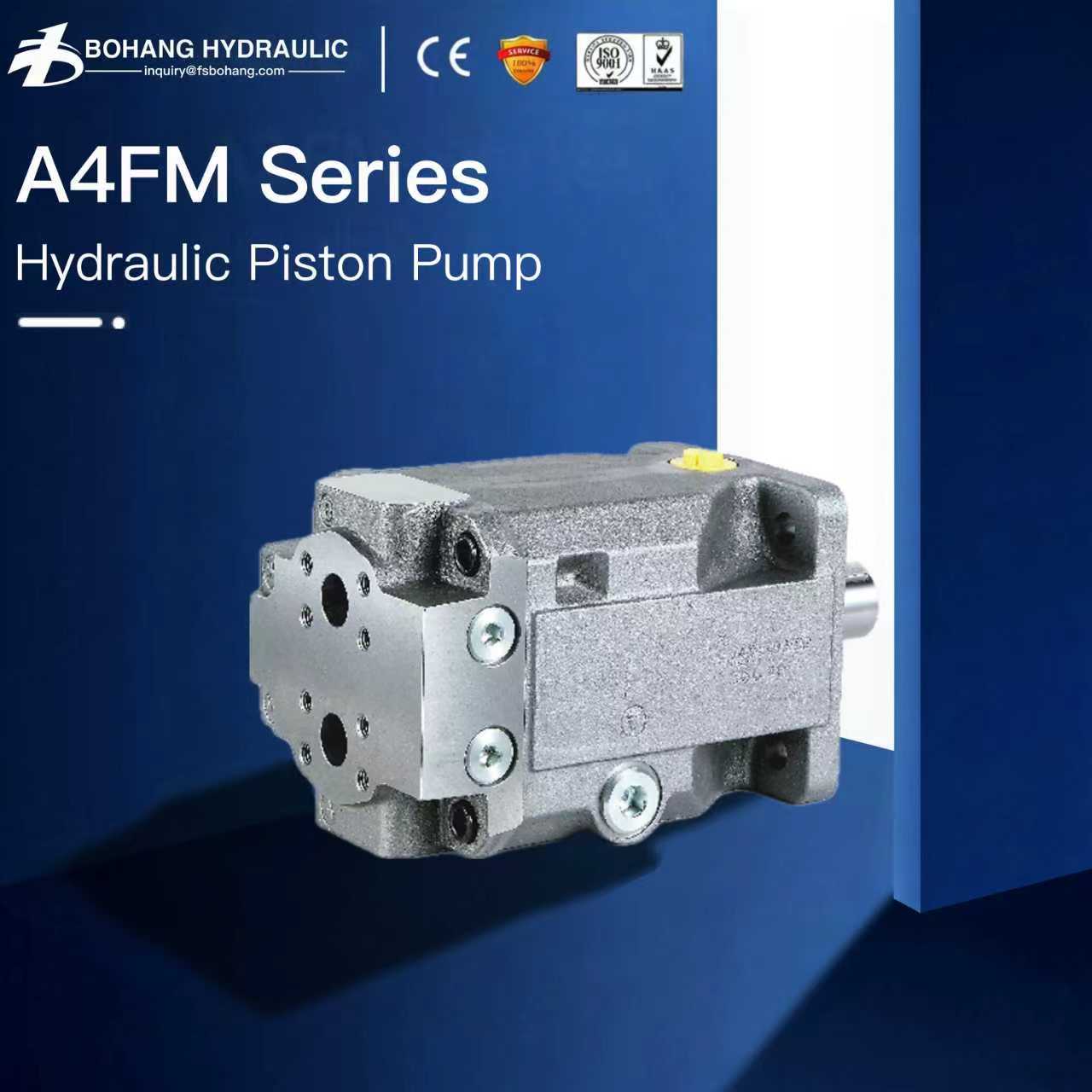
A4FM Replacement Axial Piston Fixed Motor is a high-pressure displacement motor designed to deliver stable rotary power in open- and closed-loop hydrostatic drive systems. Built with proven swashplate technology, it provides predictable speed and torque, high efficiency, long service life and a compact installation footprint. For applications that do not require the adjustable output of a variable displacement hydraulic motor, the A4FM offers a reliable solution for demanding mobile and industrial equipment.
1. Proven swashplate technology: The axial piston rotary group provides efficient conversion of hydraulic energy into continuous mechanical rotation.
2. Open and closed-loop operation: Suitable for hydrostatic drive systems using either open-circuit or closed-circuit hydraulic configurations.
3. High-pressure capability: All listed displacement sizes are rated for nominal pressures up to 350 bar and maximum pressures up to 400 bar.
4. Compact installation: The space-saving housing is designed for specialized drive arrangements where a conventional A2FM motor configuration may not be suitable.
5. Application-matched replacement: Displacement, mounting flange, shaft type, port arrangement and rotation direction can be checked against the existing motor configuration to support accurate replacement selection.
FAQ
Q1. Can a replacement axial piston fixed motor directly replace the original motor?
It can be used as a replacement only when both the hydraulic specifications and installation interfaces match. Displacement alone is not enough. Check the complete model code, series, shaft and spline, mounting flange, pilot diameter, port arrangement, rotation direction, seal material and pressure rating. The A4FM replacement range shown on this page includes 71, 125, 250 and 500 cm³/rev sizes, with a nominal pressure of 350 bar and a maximum pressure of 400 bar.
Q2. What information is needed to identify the correct replacement motor?
The best starting point is a clear photo of the original nameplate and its complete model code. You should also provide photos of the shaft, mounting flange, working ports and drain ports. When the nameplate is missing or unreadable, measure the shaft diameter or spline, flange dimensions, pilot diameter, bolt-hole spacing and port sizes, and provide the machine model, application, rotation direction, operating pressure and approximate flow. These details help prevent installation delays, incorrect rotation and poor motor performance.
Q3. How do I choose the correct displacement for an axial piston fixed motor replacement?
For most replacement projects, use the same displacement as the original motor unless the hydraulic system has been recalculated. With a fixed displacement motor, a larger displacement normally produces more torque at the same pressure but runs more slowly at the same inlet flow. A smaller displacement runs faster but provides less theoretical torque at the same pressure. Changing displacement without checking pump flow, working pressure, gearbox ratio and load requirements may cause low speed, insufficient torque or overspeed.
Q4. Can a fixed displacement axial piston motor replace a variable displacement motor?
It is generally not a direct replacement. A variable displacement motor can change its displacement to adjust the relationship between speed and torque, while a fixed displacement motor maintains one displacement throughout operation. A fixed motor may only be suitable when the pump, control valves, gearbox and operating cycle can provide the required speed and torque range without motor displacement control. The complete drive system should be reviewed before making this change.